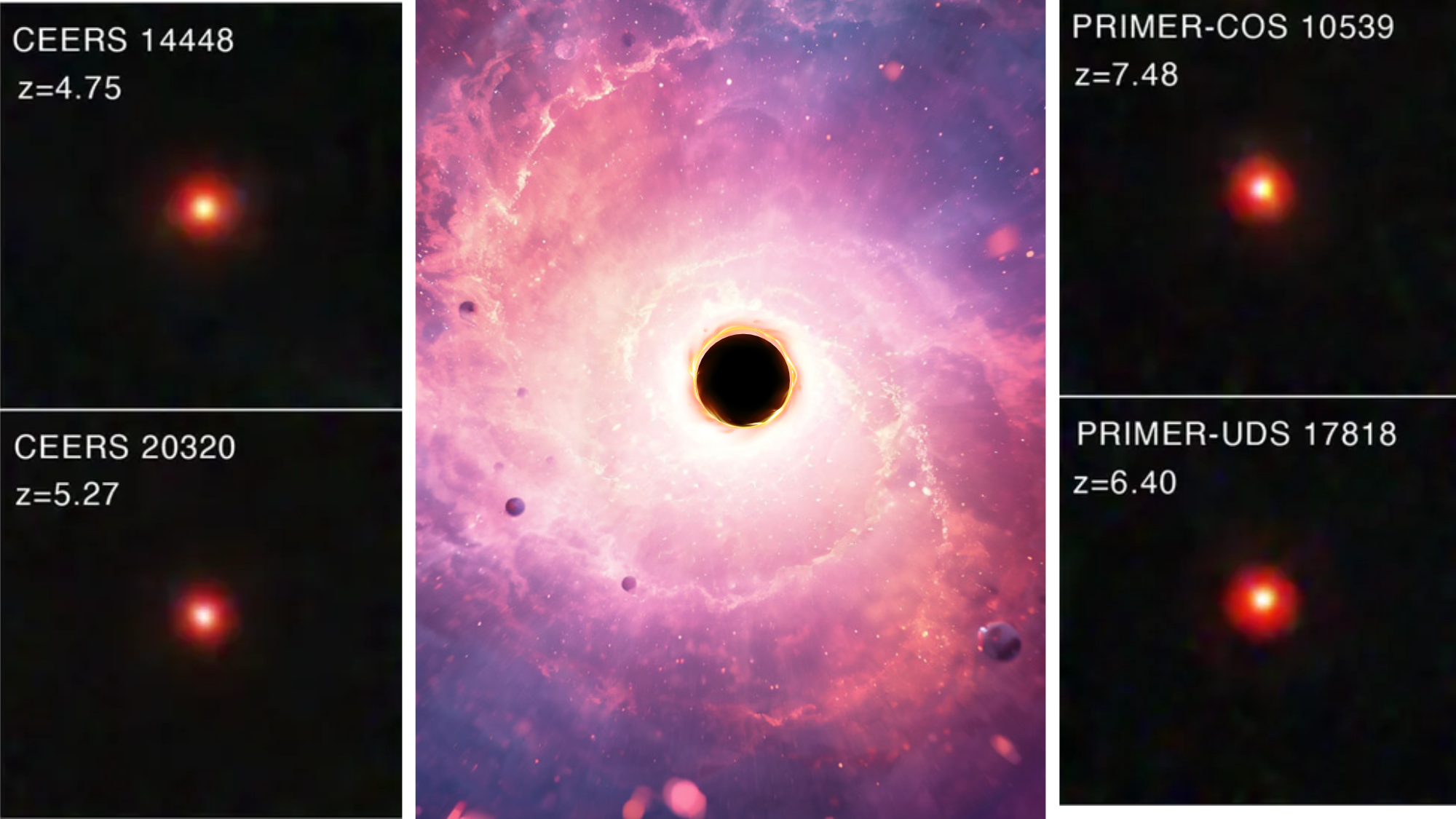
Astronomers at Johns Hopkins University have used James Webb Space Telescope observations to examine whether a class of puzzling early-universe objects known as Little Red Dots could be powered by primordial black holes — a kind of black hole theorised to have formed in the first moments after the Big Bang. The work, reported by Space and published in June in Physical Review Letters, focuses on a single Little Red Dot called blackAbell 2744-QSO1, or QSO1, which is seen as it appeared roughly 700 million years after the Big Bang.
The researchers modelled how an object like QSO1 could arise from a primordial black hole, and concluded that the most plausible of three scenarios they considered involves a relatively small primordial black hole drawing in surrounding gas and energy until it reached the object's observed size.
Why it matters
Little Red Dots are among the surprises Webb has delivered since it began surveying the distant universe. According to Space, these objects appear to vanish entirely before the universe reaches two billion years of age, and astronomers have not settled on what they are.
The question matters beyond the objects themselves. Primordial black holes were first proposed by Stephen Hawking in the 1970s, but no firm evidence of their existence has been found. If they are real, they would be older than stars, galactic dust and any element heavier than hydrogen and helium. Confirming them would also bear on what conditions were like in the earliest era of cosmic history — a period the Johns Hopkins team describes as poorly understood.
A different origin story
The distinction the team is testing is one of birth, not appearance. As study team member Valerio De Luca, of Johns Hopkins' Department of Physics and Astronomy, explained in a statement, an ordinary black hole forms through the gravitational collapse of a star, while a primordial one would come from the physics of the early universe, when space was expanding at an exponential rate, before any stars existed. The mechanisms behind the two are therefore not the same.
That leaves a practical problem: telling them apart. De Luca said Little Red Dots could surround astrophysical black holes — and probably many do — but could also be primordial black holes if such objects exist. The task, he said, is working out which ones are primordial and how that could be detected.
QSO1 was chosen because of its composition. Space reports that the object lies about 13.1 billion light-years from Earth and is made up almost entirely of hydrogen and helium. Since those were the first elements in the universe, the object may be less contaminated — and so more genuinely primordial — than other Little Red Dots.
Constraints on the model
Any explanation involving primordial black holes has to fit what cosmology already allows. Study team member Loris Del Grosso, also at Johns Hopkins, said cosmological observations place limits on how many primordial black holes can exist in total, and on how many can be crowded into a single cluster. Those limits shaped the scenarios the team tested.
The group ran three possibilities and found that gradual growth from a smaller seed was the most likely route to an object like QSO1. Del Grosso described the result as pushing a previously open idea further, by showing that some pathways are more probable than others.
What happens next
The team now plans to extend the analysis to the roughly 100 other Little Red Dots Webb has observed, to gauge how many could have begun as primordial black holes. That wider survey is the step that could supply the evidence long missing for these hypothesised objects.
De Luca framed the stakes plainly: if primordial black holes do exist, then something in the early universe must have produced them, and establishing that would mark a major advance in physics.